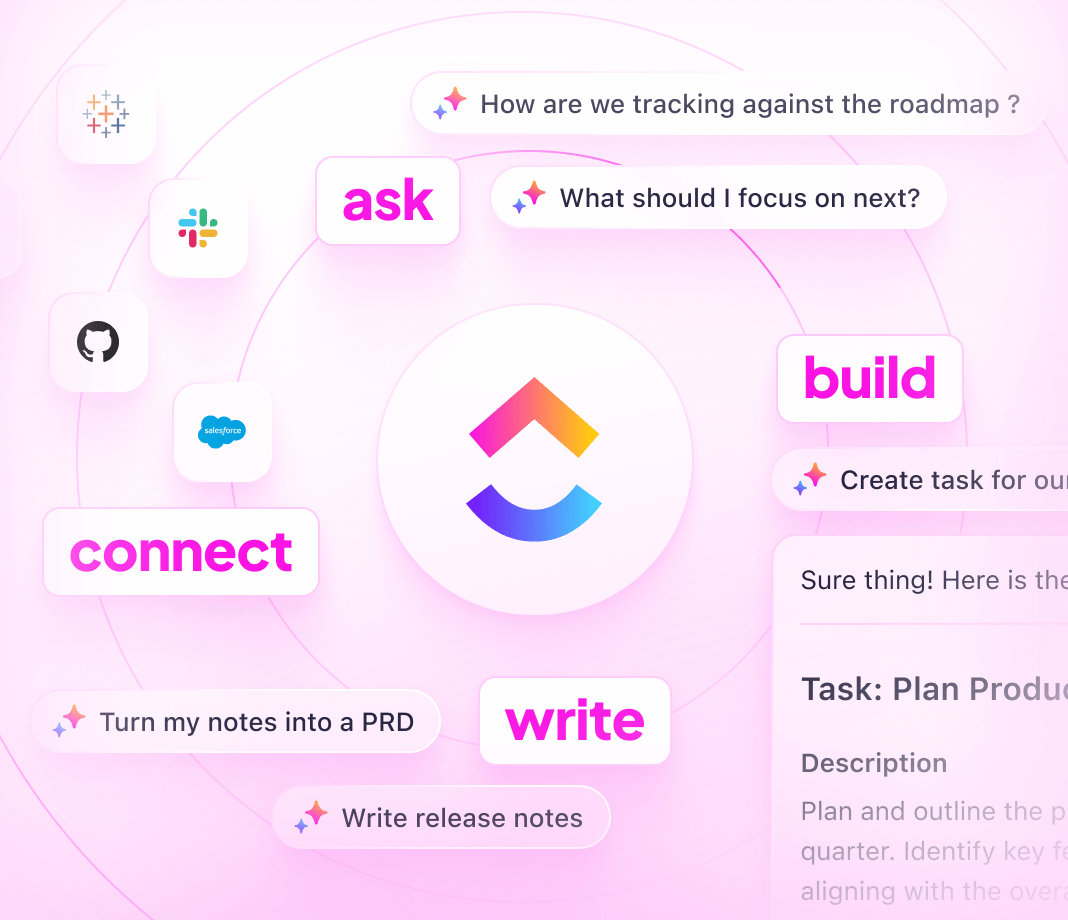
Supercharge your data analysis with SQL AI Agents, turning complex queries into quick insights without lifting a finger. Let ClickUp Brain manage the heavy lifting of data wrangling, so you can focus on making impactful decisions fast.
How AI Agents Work for SQL
AI Agents are transforming the world of database management, making it easier, faster, and smarter. For anyone working with SQL, AI Agents serve as invaluable assistants, automating tasks that traditionally would require hours of manual labor. They help you write complex queries, troubleshoot issues, and optimize database performance, all while learning and adapting to your workflow.
There are various types of AI Agents that can be applied in the world of SQL:
- Predictive Agents: Forecast system performance and identify potential bottlenecks.
- Analytical Agents: Provide insights from data patterns and trends.
- Automated Assistants: Generate query suggestions and automate repetitive tasks.
- Competitors: Look at names like ChatGPT for AI Agents that simplify SQL complexities, and DataRobot for predictive analytics.
In practice, imagine you're working with a massive dataset and need to extract specific insights. An Automated Assistant could generate SQL queries for you based on a simple prompt. For example, "Show me the monthly sales totals for the last year" translates into a complex SQL query in seconds. Meanwhile, Predictive Agents keep an eye on your database's performance, alerting you to potential slowdowns before they become problems. Analytical Agents continuously analyze data trends, helping you make informed decisions with just a glance at their dashboards. AI Agents for SQL not only save time but provide peace of mind, allowing professionals to focus on strategic decisions rather than technical grunt work.
Benefits of Using AI Agents for SQL
Leveraging AI Agents for SQL transforms how businesses handle their data and unlocks new potential for efficiency and decision-making. Here are some practical benefits and significant business impacts:
Automated Query Generation
- AI agents efficiently generate SQL queries, saving time and reducing human errors. No more wrestling with complex syntax—leave it to AI. This means faster data manipulation and the ability to focus on strategic tasks instead of manual coding.
Improved Data Insights
- AI Agents sift through vast amounts of data quickly, highlighting patterns and insights that might be missed manually. Businesses gain a clearer understanding of trends and can make informed decisions faster, maintaining a competitive edge.
Real-Time Data Analysis
- With the ability to process and analyze data in real time, AI agents provide up-to-date insights. This capability allows businesses to react swiftly to market changes or operational issues, enhancing agility and responsiveness.
Resource Optimization
- By automating routine data tasks, AI Agents free up valuable time for IT and data teams. This leads to better resource allocation, enabling teams to concentrate on innovation and strategic initiatives rather than get bogged down in routine SQL tasks.
Enhanced Security
- AI Agents can monitor database access and query patterns for suspicious activity, adding an extra layer of security. This proactive measure helps protect sensitive data and ensures compliance with data protection regulations, instilling confidence in stakeholders.
Harnessing AI Agents for SQL is not just a technological upgrade; it's a strategic shift that drives business results. Optimize your data handling, unleash insights, and keep your business moving forward efficiently and securely.
Harness the Power of AI Agents for SQL Tasks
AI Agents are more than just digital assistants; they're the extra set of hands you need to manage those pesky SQL tasks with precision and ease. Let’s dig into some practical ways these intelligent agents can transform your SQL workflow:
Automated Query Generation
- Generate complex SQL queries from natural language prompts.
- Translate business questions into accurate SQL statements.
- Speed up data extraction with minimal SQL knowledge required.
Query Optimization
- Identify inefficient queries and suggest modifications for speed improvements.
- Analyze execution plans to pinpoint bottlenecks.
- Recommend indexing strategies to improve response times.
Data Analysis & Reporting
- Automate data aggregation for detailed reports without manual oversight.
- Convert large volumes of data into visually appealing charts.
- Schedule regular data pulls and report generation at your convenience.
Error Detection and Correction
- Detect syntax errors and suggest corrections before query execution.
- Highlight potential logic errors in complex queries.
- Automatically fix common SQL errors to ensure smooth operations.
Schema Management
- Analyze database schemas to suggest improvements.
- Automate database versioning and change tracking.
- Maintain referential integrity by monitoring changes across tables.
Continuous Education & Learning
- Provide SQL tips and best practices as you type.
- Suggest learning resources based on your query patterns.
- Encourage adopting cutting-edge SQL techniques with live examples.
Incorporating AI Agents into your SQL processes not only streamlines operations but also upskills you and your team, turning uncharted data territories into a navigable landscape. Prepare to enjoy a programming experience that feels less like work and more like play!
Supercharging Your Workspace with ClickUp Brain Chat Agents
Welcome to the future of productivity! 🚀 ClickUp Brain Chat Agents are here to revolutionize how you interact within your ClickUp Workspace. Let's journey together through how these AI Agents can make your workflow seamless and efficient.
Meet the Agents That Elevate Your Game:
1. Answers Agent
- Automate Responses: Imagine never having to dive through endless threads to answer repetitive questions. The Answers Agent autonomously handles Queries about your products, services, or organization, ensuring quick and accurate responses.
- Knowledge Source: Choose specific resources for the Agent to reference, minimizing manual intervention and maximizing productivity.
2. Triage Agent
- Task Integration: Never miss out on an action item. The Triage Agent ensures every important chat is followed up with the proper tasks, connecting the dots between conversation and action.
- Criteria-Based Detection: Set your criteria and let the Agent identify which chat requires task creation, keeping your workflow slick and organized.
Create & Customize Your Agent
- Tailor to Your Needs: Start fresh and create a Chat Agent from scratch, or customize prebuilt Agents with specific prompts and objectives suited to your unique needs.
A Dash of SQL AI Agent Magic
While ClickUp Brain operates within your Workspace, the concept parallels the functionality of an AI Agent that could streamline SQL tasks. Imagine a SQL AI Agent identifying which database queries need action in the same seamless and autonomous manner that ClickUp Brain Agents do within your digital realm.
Key Characteristics at a Glance:
- Autonomy: Agents make decisions and adapt based on the instructions and data they can access.
- Reactivity: Real-time responsiveness to changes enhances communication and task management efficiency.
- Proactivity: Initiating actions ensures objectives are actively pursued rather than just waiting for prompts.
- Customizability: Fine-tune Agents to align perfectly with your Workspace goals.
With ClickUp Brain Chat Agents, transform the way you work by automating tasks, streamlining communication, and ensuring no critical information slips through the cracks. Get ready to witness a paradigm shift in productivity, all within your trusty ClickUp Workspace! 🌟
Navigating Challenges with SQL AI Agents
SQL AI Agents can transform how we interact with our databases, making querying more intuitive and efficient. However, like any powerful tool, they come with some challenges. Let's dive into these potential pitfalls, understand their limitations, and explore how you can steer through them like a pro.
Common Pitfalls and How to Address Them
1. Understanding Context
AI agents do their best to analyze and respond based on provided context, but it's essential to provide clear and specific instructions to avoid misunderstandings.
Solution:
- Be explicit in your queries. The more specific your request, the better the results.
- Regularly update training data to ensure the AI is operating with the most relevant context.
2. Handling Ambiguity
Natural language can be ambiguous. Without clear parameters, AI agents may struggle to return accurate results.
Solution:
- Establish standard query templates that minimize ambiguity.
- Test queries with various phrasing to discover how the AI interprets different inputs.
3. Data Security Concerns
AI agents accessing databases can present security challenges, especially with sensitive information.
Solution:
- Implement strict access controls and regular audits to monitor AI interactions with your database.
- Limit AI agent permissions to necessary datasets only.
4. Performance Overhead
AI-assisted querying may introduce additional processing time, especially with large datasets.
Solution:
- Optimize database performance by indexing frequently queried columns.
- Consider the complexity of queries and evaluate if simpler, more efficient approaches are possible.
5. Dependence on AI Decisions
Relying heavily on AI-generated outputs can sometimes result in missing insights from manual analysis.
Solution:
- Maintain a balance between automated and manual querying methods.
- Regularly review AI-generated results to ensure they align with business objectives and human intuition.
6. AI Training and Updates
AI agents need continuous updates and training to adapt to new patterns and data structures.
Solution:
- Schedule regular training intervals for the AI agent.
- Collect user feedback to identify areas where the AI could improve its understanding or accuracy.
Conclusion
AI agents are powerful allies in database management, simplifying complex tasks and enhancing productivity. By understanding their challenges and strategically implementing solutions, you'll harness their potential while avoiding common setbacks. Remember, the best way to work with AI is by being an active partner in its evolution.