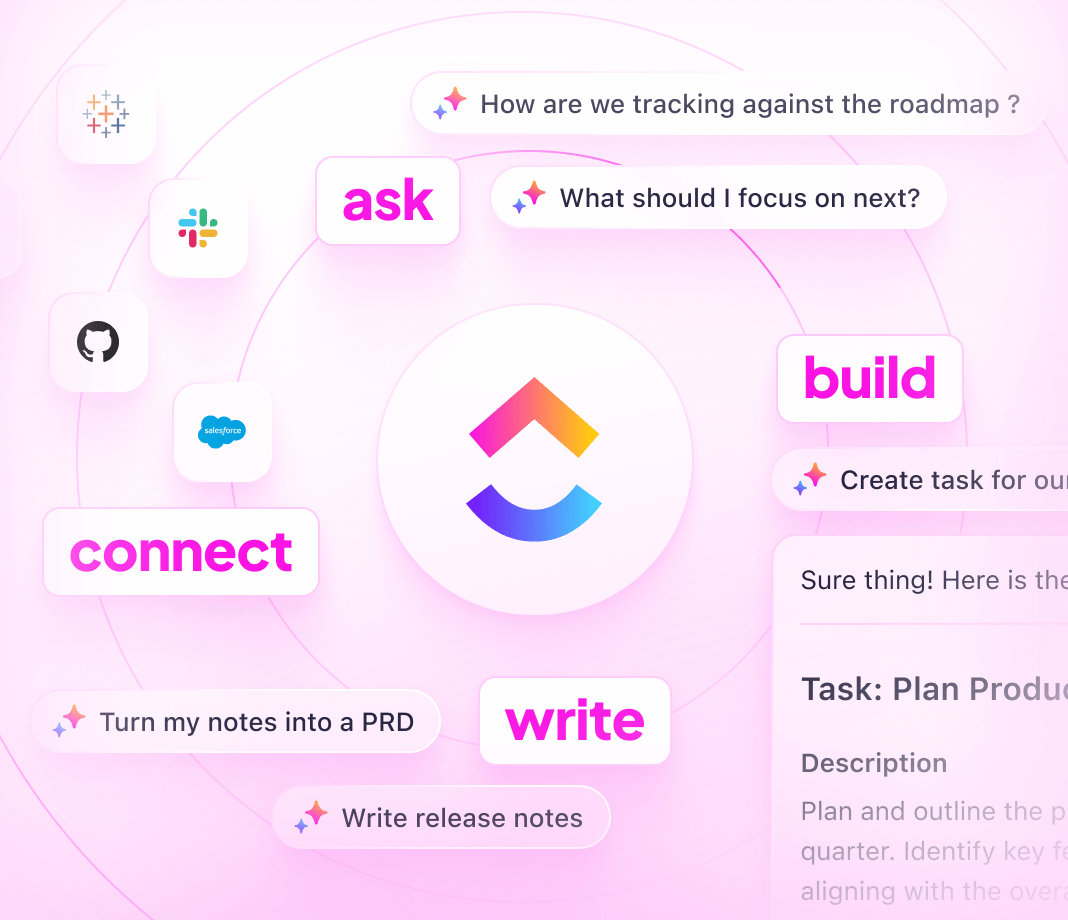
Transform the way you tackle software testing with AI Agents that identify bugs, automate test cases, and optimize your workflow for maximum efficiency and accuracy. Let ClickUp Brain amplify your productivity and ensure your software runs flawlessly every time!
Software Testing AI Agents: Your New Testing Partner
AI agents for software testing are your trusty sidekicks in ensuring apps and systems run smoothly. They help catch bugs, ensure quality, and save valuable time by automating repetitive tasks. These smart assistants learn from data, predict potential issues, and adapt to new software environments, making them indispensable in the fast-paced world of software development.
Types of Software Testing AI Agents
- Test Automation Agents: Automate repetitive test execution to increase efficiency.
- Bug Detection Bots: Identify and report bugs faster than you can say "debug."
- Performance Analysis Agents: Monitor and assess software performance under different conditions.
- Regression Testing Agents: Ensure that new code changes don't negatively affect existing functionality.
Making Software Testing Smarter
Imagine having an AI agent that can autonomously sift through thousands of lines of code to detect inconsistencies or potential threats. For instance, a bug detection bot can analyze your latest update and promptly flag suspicious changes. It’s like having a vigilant watchdog that keeps an eye on code without breaking a sweat.
Consider a scenario where your team releases a new feature. A regression testing agent will diligently recheck impacted areas to ensure everything still works like a charm. Or perhaps you're worried about how your app will handle a million users at once—let a performance analysis agent evaluate this for you, providing insights and improvement suggestions. Each type of AI agent brings its unique set of strengths to the table, making your software testing as seamless as possible.
Benefits of Using AI Agents for Software Testing
Leveraging AI Agents in software testing is a game-changer. Here's why:
Efficiency Boost
- AI Agents turbocharge testing processes by automating repetitive tasks. This saves time, minimizes human error, and ensures higher productivity, allowing your team to focus on more strategic challenges.
Cost Savings
- Automating test cases reduces the need for extensive manual testing, cutting down labor costs. AI-driven testing can also quickly identify defects, reducing the potential expenses associated with post-release bug fixes.
Enhanced Test Coverage
- AI Agents can execute numerous test scenarios that may not be feasible manually, ensuring comprehensive test coverage. They can simulate a vast array of user behaviors and edge cases, improving software reliability.
Faster Time to Market
- By accelerating the testing phase, AI Agents help bring high-quality software to market faster. This agility can be a strategic advantage, keeping you ahead of competitors and meeting customer demands promptly.
Continuous Improvement
- AI Agents learn and adapt. They use historical test data to refine testing strategies, improving over time. This continuous learning loop ensures that testing processes evolve, maintaining alignment with changing software landscapes and requirements.
Embrace AI Agents for a robust, efficient, and forward-thinking approach to software testing.
AI Agents for Software Testing: Practical Applications
Welcome to the era of AI agents revolutionizing software testing! These intelligent allies can save time, reduce errors, and crank up your testing efficiency. Let’s take a look at some practical ways AI agents can enhance your testing process.
Automated Test Case Generation
- Generate test scenarios by analyzing application requirements and user stories.
- Create comprehensive test cases using historical data and predictive algorithms.
Regression Testing
- Run repeatable regression tests automatically with pinpoint accuracy.
- Compare current and past test results to detect unexpected changes.
Bug Detection and Reporting
- Identify anomalies through pattern recognition and machine learning.
- Categorize and prioritize bugs based on potential impact and frequency.
Performance Testing
- Simulate a wide range of user interactions to evaluate system performance under load.
- Identify bottlenecks and suggest optimizations by analyzing performance trends.
Continuous Integration and Delivery (CI/CD) Pipeline Integration
- Detect and run tests for every code change to ensure quality with rapid feedback.
- Automate decision-making processes like build promotion based on test results.
Compatibility Testing
- Assess multi-platform compatibility quickly by automating cross-browser and device testing.
- Ensure new updates work seamlessly across diverse environments.
User Interface (UI) Testing
- Execute repetitive UI tests to validate layouts, elements, and navigation paths.
- Use image recognition to pinpoint visual defects in the user interface.
Security Testing
- Perform vulnerability scans and penetration tests automatically to identify weaknesses.
- Analyze network traffic and application interactions for potential security threats.
Test Data Management
- Generate synthetic test data to preserve user privacy while facilitating thorough test coverage.
- Automatically sanitize and mask sensitive information in test data sets.
Test Optimization and Maintenance
- Optimize test suites by identifying redundant test cases.
- Maintain tests by updating scripts automatically in response to changing UI elements or logic.
Predictive Analytics
- Forecast potential failure points using AI-driven predictive analytics.
- Prioritize testing efforts based on risk assessments and historical failure data.
These applications are just the tip of the iceberg when it comes to how AI agents can supercharge your software testing process. Don’t just work harder—work smarter with AI agents as your dependable sidekick! 🚀
Supercharge Your Workspace with ClickUp Brain Chat Agents!
Welcome to a world where workplace chatter transforms into a productivity powerhouse! ClickUp Brain's Chat Agents are here to seamlessly integrate into your Workspace, boosting efficiency and keeping everyone in sync. Let's break down what these incredible AI companions can do for you.
Get Acquainted with ClickUp Brain's Chat Agents
Harness the wisdom of Chat Agents, each designed with distinct focus areas to cater to your Workspace needs. They're not just reactive, they're proactive, operating autonomously to help you achieve your goals. Their customizable nature allows you to fine-tune them to your heart's content. Let's see how they fit into your world:
Answers Agent
Picture this: Your team is buzzing with questions about your products and services, and you're drowning in requests for clarifications. Enter the Answers Agent! This genius automates responses to these everyday inquiries, pulling data from knowledge sources of your choice. Not only does this save precious time, but it also ensures swift, accurate communication.
Triage Agent
Never miss an action item again with the game-changing Triage Agent. It's your go-to for ensuring that task-related threads are connected appropriately. This Agent smartly links relevant Chat threads with tasks, keeping everyone in the loop and safeguarding context—key for maintaining project flow!
ClickUp Brain & Software Testing
Imagine bringing these dynamic Chat Agents into your Software Testing process. Your team can leverage the Answers Agent to tackle repetitive queries from developers and stakeholders, swiftly accessing product specs and testing protocols. Meanwhile, the Triage Agent ensures each testing issue flagged in Chat is properly translated into an actionable task, ensuring no bug slips through the cracks.
Ready to level up your ClickUp Workspace? Meet your new favorite colleagues and let them handle the mundane, so you can focus on building the future!
Navigating Challenges with AI Agents in Software Testing
Implementing AI Agents in software testing can revolutionize your workflow, but like any technology, it's not without its challenges. Let's explore the common pitfalls and provide actionable solutions so you can unleash the full potential of AI Agents with confidence.
Common Pitfalls and Limitations
1. Data Quality and Quantity
- Challenge: AI Agents rely heavily on data to function effectively. Poor-quality or insufficient data can lead to inaccurate results.
- Solution:
- Ensure data is clean, well-organized, and relevant.
- Regularly update datasets and use augmentation techniques to enhance data variety.
2. Integration with Existing Systems
- Challenge: Integrating AI Agents with legacy systems and various tools can be complex.
- Solution:
- Conduct a thorough assessment of current systems.
- Develop a step-by-step integration plan with a focus on interoperability.
- Use APIs and middleware solutions to bridge gaps.
3. Overfitting and Underfitting
- Challenge: AI models may either overfit on the training data or underfit, leading to poor generalization.
- Solution:
- Use techniques like cross-validation and regularization.
- Continuously test and refine models with different datasets.
4. Interpretability and Explainability
- Challenge: AI decisions can sometimes be a "black box," making it hard to understand why a certain outcome was reached.
- Solution:
- Use interpretable models where possible.
- Implement explainable AI tools to provide insights into decision-making processes.
5. Maintenance and Updates
- Challenge: AI Agents require ongoing maintenance and updates to remain effective.
- Solution:
- Establish a monitoring system to track performance.
- Schedule regular updates and retraining sessions to keep models relevant.
6. Bias and Fairness
- Challenge: AI systems can inherit biases present in training data, leading to unfair outcomes.
- Solution:
- Conduct bias audits and use fairness-aware algorithms.
- Ensure diverse and representative training datasets.
7. Cost and Resource Allocation
- Challenge: Implementing AI Agents can incur significant costs in terms of resources and finances.
- Solution:
- Start with a pilot project to assess value and ROI.
- Consider cloud-based solutions to reduce infrastructure costs.
Proactive Strategies for Success
- Educate and Train Teams: Equip your team with the necessary skills to use AI Agents effectively through workshops and training sessions.
- Set Clear Goals: Define specific, measurable objectives for AI implementation to ensure alignment with business goals.
- Iterative Approach: Adopt an iterative approach to implementation, allowing for feedback, refinements, and adjustments based on real-world performance.
Bringing AI Agents into your software testing strategy doesn't have to be daunting. With awareness of these challenges and strategic solutions, you can smoothly integrate AI, paving the way for enhanced efficiency and innovation. Happy testing!