
OKR (Objectives and Key Results)
A quarterly goal framework that pairs one qualitative Objective with 3 to 5 measurable Key Results, giving teams shared direction and a built in scoring system to track progress.
How to Write Effective OKRs
The most common writing mistake is making Objectives that are actually Key Results.
- “Increase onboarding completion by 5%” is measurable and specific, which makes it a Key Result.
- A proper Objective would be “Build an onboarding experience that new hires recommend to friends.”
The Objective captures the qualitative ambition. The Key Results capture the evidence.
Good Key Results include three elements: a metric, a starting value, and a target value. “Reduce average onboarding time from 14 days to 7 days” passes this test because anyone can verify whether it happened. “Improve the onboarding process” fails because no two people would agree on what “improved” means.
Set 3 to 5 Objectives per team per quarter, each with 3 to 5 Key Results. More than that dilutes focus. If everything is a priority, nothing is. The discipline of choosing fewer goals forces honest decisions about what actually matters this quarter versus what can wait.
At least one Key Result per Objective should be a stretch goal that requires exceptional effort or creative problem solving. This prevents the natural tendency to set targets you already know you can hit. The discomfort of ambitious targets is a feature of the system, not a flaw.
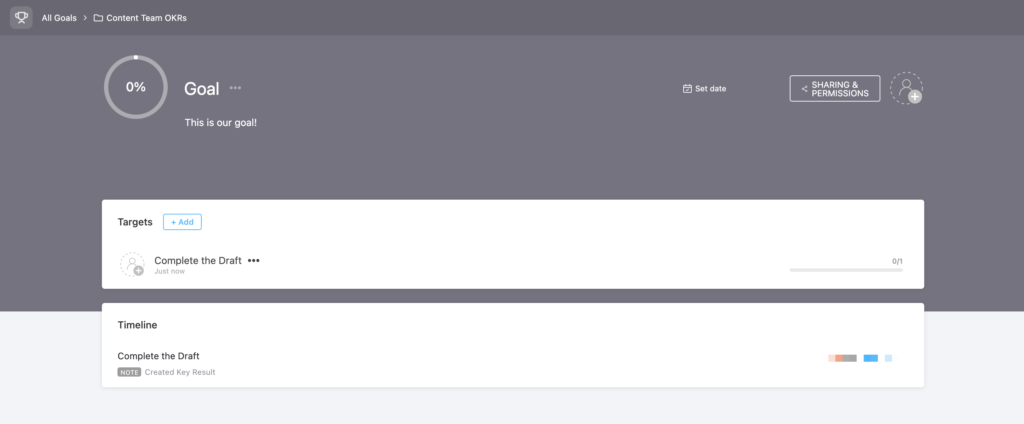
ClickUp Goals maps directly to the OKR structure. Create an Objective as a Goal, add Key Results as measurable Targets (number, currency, percentage, or true/false), and track progress automatically as linked tasks and projects move forward. Roll up team Goals into a company level folder to see alignment at a glance.
OKR Examples
A concrete example makes the framework click. Here is an OKR a content marketing team might set for Q3.
Objective: Become the most trusted resource in our category for first time buyers.
Key Results:
| Key Result | Baseline | Target |
|---|---|---|
| Organic traffic from informational queries | 30,000/mo | 75,000/mo |
| Average time on page for buyer guide content | 1:45 | 3:00+ |
| Backlinks from industry publications | 4 | 12 |
| Email subscribers from content CTAs | 200 | 500 |
Notice the Objective is qualitative. You cannot directly measure “most trusted.” But if the team hits 3 of 4 Key Results, there is strong evidence they are moving toward that ambition. Notice also that the Key Results measure outcomes (traffic, engagement, authority, subscribers), not activities (publish 20 articles, redesign the blog).
Common OKR Mistakes
Writing Key Results as tasks instead of outcomes is the single most frequent failure. “Launch the redesigned homepage” is a task. “Increase homepage conversion rate from 2.1% to 3.5%” is an outcome. You can complete the task and still fail the outcome. OKRs measure results, not activities.
Linking OKR scores directly to compensation is the second most damaging mistake. When bonuses depend on scores, teams set conservative targets to guarantee high marks. Google explicitly separates OKR scoring from performance reviews and pay decisions for this reason.
Skipping weekly check ins turns OKRs into a set and forget exercise. Goals set in January and reviewed in March produce surprises, not results. A 15 minute weekly review where each Key Result gets a score and a one sentence status update catches problems early and keeps the system alive.
Setting too many OKRs fragments focus. Organizations new to the framework often create 8 to 10 Objectives per team. Three to four is the ceiling. Beyond that, scoring becomes burdensome and the clarity benefit disappears.
Never tie OKR scores directly to bonuses or promotions. The moment compensation depends on scores, teams set conservative targets to guarantee high marks. Google learned this in the early 2000s and has kept OKR scoring completely separate from performance reviews and pay decisions ever since.
When OKRs Fit (and When They Do Not)
OKRs shine when multiple people or teams need to coordinate toward shared outcomes. For teams of 5 to 15, they provide direction without micromanaging individual tasks. For organizations of 50 or more, they become a communication tool: when every team’s OKRs are visible company wide, anyone can see how their work connects to organizational priorities.
For remote and distributed teams, OKRs compensate for the informal alignment that happens naturally in a shared office. When you cannot see what a colleague is working on by walking past their desk, shared OKRs provide that visibility digitally.
OKRs are not always the right choice. Solo contributors with clear deliverables often do better with 3 SMART goals per quarter. Teams smaller than 5 rarely need the overhead of formal OKR cycles. And organizations with fixed scope compliance work (government contracts, regulated reporting) may find that the stretch goal philosophy conflicts with their need for predictable delivery.
The framework works best when the work is creative, cross functional, or rapidly evolving. If your team’s output is routine and well defined, simpler goal systems will serve you with less process overhead.
Your Next Steps
2 resources that take you from concept to implementation.
How OKR (Objectives and Key Results) Compares
Common Questions About OKR (Objectives and Key Results)
What does OKR stand for?
OKR stands for Objectives and Key Results. An Objective is a qualitative statement of what you want to achieve. Key Results are 3 to 5 quantitative metrics that measure whether you are achieving it. The framework was developed at Intel in the 1970s and popularized by Google starting in 1999.
How many OKRs should a team set per quarter?
Three to four Objectives per team, each with 3 to 5 Key Results. More than that fragments focus and makes weekly scoring burdensome. At the individual level, 2 to 3 personal OKRs that align with the team’s Objectives is typical.
What is a good OKR score?
On the standard 0.0 to 1.0 scale, 0.7 is considered strong because Objectives should be ambitious enough that a perfect score means the target was too easy. Scores below 0.3 indicate either an unrealistic goal or an execution failure. Consistently scoring 1.0 suggests the team is not stretching enough.
Should OKR scores affect bonuses or performance reviews?
Most practitioners recommend keeping OKR scores separate from compensation. When scores determine pay, teams set conservative targets to guarantee high marks, which undermines the stretch goal philosophy. OKR data can inform performance conversations, but the score itself should not determine bonuses.
What is the difference between OKRs and KPIs?
OKRs are time bound goals set quarterly to drive specific change. KPIs are ongoing metrics that monitor operational health continuously. A KPI might be customer retention rate tracked weekly. An OKR might be improving retention from 85% to 92% by end of Q3. OKRs drive change while KPIs track the baseline.
Can a small team of 3 to 4 people use OKRs effectively?
Small teams can use OKRs, but the process overhead may not be justified unless they need to coordinate with other teams. For a team of 3 to 4 with clear deliverables, SMART goals or a simple quarterly priority list often provides similar clarity with less ceremony.