
Board Meeting Agenda Template: A Governance Ready Format
A formal board meeting agenda following Robert’s Rules of Order. Includes every governance section from call to order through adjournment, with motion tracking, vote recording, and time allocations for a 90 minute meeting.
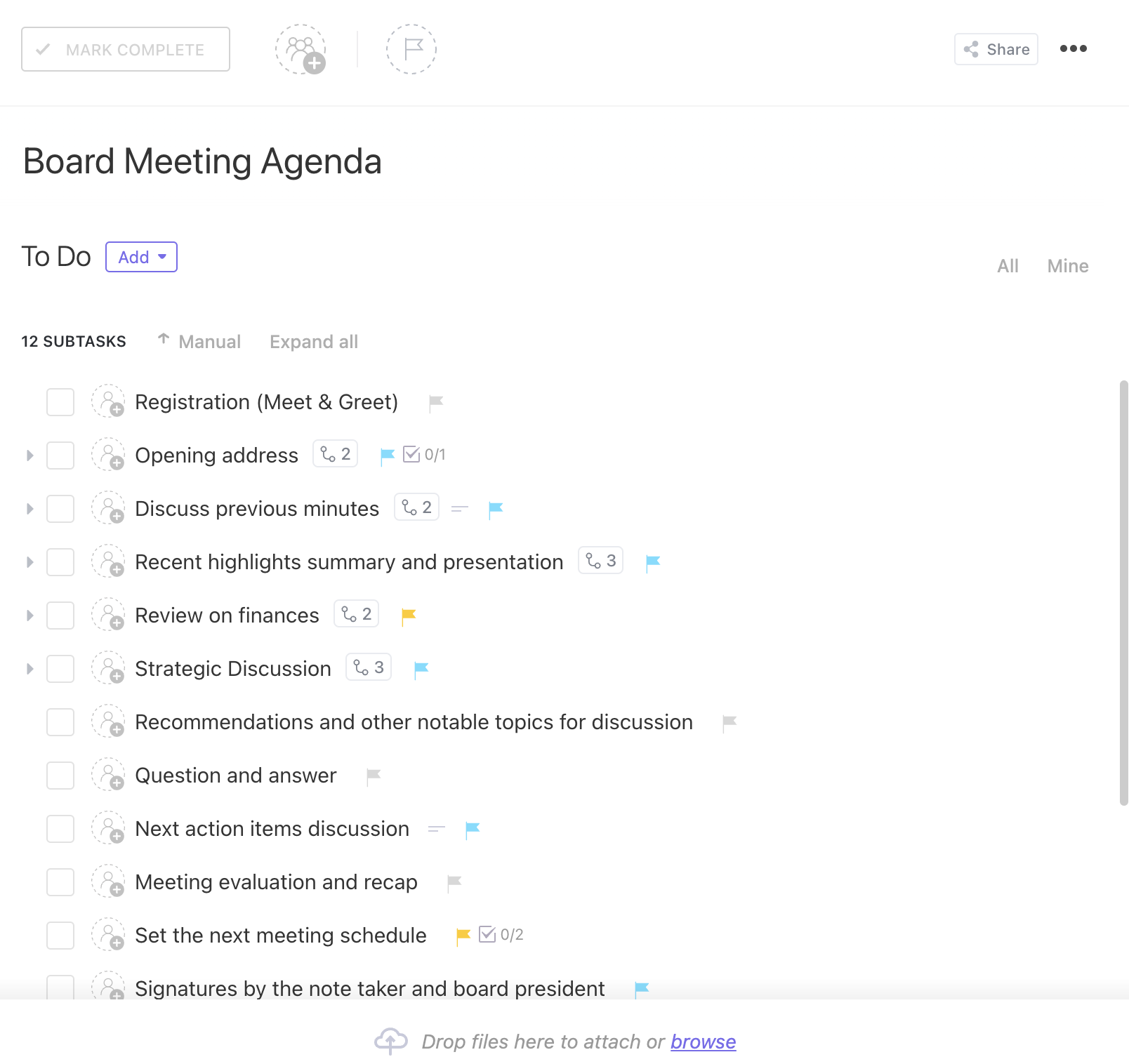
What This Includes
- Call to Order section with quorum verification checklist and attendance log
- Consent Agenda block for routine approvals (previous minutes, standard reports)
- Officer Reports section: Chair, Treasurer (with financial summary fields), Secretary
- Committee Reports section with status update format and recommendation fields
- Old Business section for motions tabled or continued from prior meetings
- New Business section with motion, second, discussion, and vote tracking
- Action Items summary table with owner, deadline, and status columns
- Adjournment section with next meeting date, time, and location
How to Use This Template
Customize and Distribute
Fill in the meeting date, time, location, and list of board members. Add your organization’s specific committees to the committee reports section. Remove any sections that do not apply (for example, not every meeting has old business). Distribute the completed agenda and all supporting documents to board members at least 7 days before the meeting, or per your bylaws.
Verify Quorum and Open
Before proceeding with any official business, confirm that a quorum is present. The standard quorum under Robert’s Rules is a majority of the board (for example, 5 of 9 directors). Record attendance in the attendance log. If quorum is not met, the board can discuss but cannot vote on motions. The chair calls the meeting to order and states the time for the record.
Work Through the Agenda in Order
Follow each section sequentially. Use the consent agenda to batch routine approvals (previous minutes, standard financial reports) into a single vote. For officer and committee reports, allow 3 to 5 minutes each unless a report requires board action. For old and new business items, follow the motion process: a member makes a motion, another seconds it, the chair opens discussion, then calls for a vote. Record every motion, second, and vote result.
Capture Action Items
As decisions are made throughout the meeting, log each action item in the summary table with a responsible owner, a specific deadline, and the expected deliverable. Read the action items back before adjournment so every board member confirms their commitments. The secretary distributes the action item list along with the draft minutes within 48 hours of the meeting.
Adjourn and Follow Up
The chair confirms the date, time, and location of the next meeting. A member makes a motion to adjourn, another seconds, and the chair records the adjournment time. After the meeting, the secretary prepares draft minutes and circulates them for review. These minutes will be the first consent agenda item at the next meeting.
This template structures the formal meeting agenda described in the Meeting Agenda guide, adapted specifically for board governance. Use it for quarterly board meetings, annual meetings, special sessions, or any meeting where official decisions require recorded votes.
What Makes a Board Meeting Agenda Different
Board meetings carry legal weight that team meetings do not. The minutes become the official record of the organization’s decisions, and directors have fiduciary obligations that require informed deliberation. A missing quorum, an unrecorded vote, or an improperly noticed meeting can invalidate decisions and create liability.
This means the agenda is not a suggestion. It is a procedural document that the chair follows in sequence. Items not on the distributed agenda can only be added during the meeting through a formal motion, which typically requires a two thirds vote under Robert’s Rules of Order.
Using a Consent Agenda to Save Time
A consent agenda bundles routine items (approval of previous minutes, standard financial reports, committee updates with no action required) into a single vote at the start of the meeting. If no board member objects, all consent items pass together. Any member can pull an item from consent to discuss it separately.
Organizations that adopt consent agendas report saving 15 to 30 minutes per meeting because they eliminate individual votes on noncontroversial items. The time savings compounds: a board that meets 6 times per year recovers 1.5 to 3 hours annually for substantive discussion on strategic matters.
After the Meeting: Minutes and Follow Up
The board secretary should distribute draft minutes within 48 hours while the discussion is still fresh. Minutes should record what was decided, not what was said. The standard format captures: motions made (with the name of the mover and seconder), vote results (passed, failed, or tabled), and action items assigned.
Board members review the draft minutes before the next meeting. At that meeting, approving the previous minutes is typically the first consent agenda item. Once approved, the minutes become the permanent legal record of the board’s actions.
Common Questions About Board Meeting Agenda Template: A Governance Ready Format
How far in advance should a board meeting agenda be sent?
At least 7 days before the meeting, along with all supporting documents (financial reports, committee updates, materials for any motions). Your organization’s bylaws may specify a different timeframe, typically 5 to 14 days. Sending materials early ensures directors come prepared to make informed decisions rather than reviewing documents during the meeting.
What is a quorum for a board meeting?
A quorum is the minimum number of board members who must be present for the meeting to conduct official business. The standard default under Robert’s Rules is a majority of the board (for example, 5 out of 9 directors). Your organization’s bylaws define the specific quorum requirement. Without a quorum, the board can discuss but cannot vote on motions.
Can board meeting agendas be changed during the meeting?
Under Robert’s Rules, adding items to the agenda during the meeting requires a motion, a second, and typically a two thirds vote to approve. Urgent matters that arise between agenda distribution and the meeting should be added under new business with advance notice to the chair. Routine changes like reordering sections usually require only a simple majority vote.