ClickUp Inspiration · Super Agents

ClickUp Support Ops Scales Quality Scoring 5x with AI Agents

Two Super Agents now score 500 tickets per week against a 52-question rubric, giving the Customer Support team back ~75 hours a week to focus on coaching and strategy.
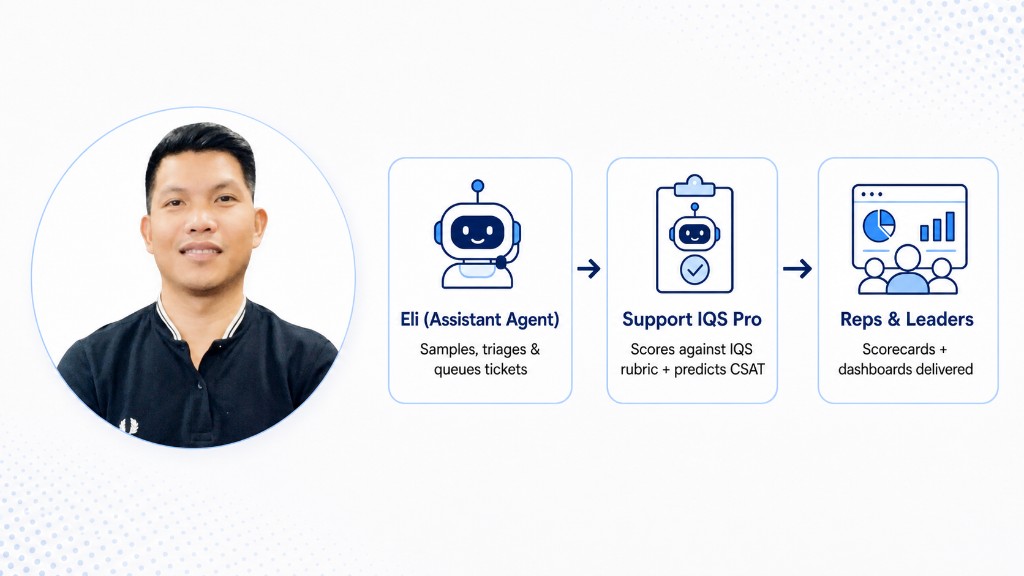
Mark Rosimo beside a scoring loop: Eli qualifies tickets, Support IQS Pro scores them, and reps and leaders receive scorecards and dashboards
Story snapshot

From 100 manual scorecards to a 5x autonomous QA operation

ClickUp's Support Ops team wrestled with a classic case of work sprawl: spent 75 hours a week manually scoring 100 tickets against a 52-question rubric, covering only a fraction of total volume.
By deploying two purpose-built Super Agents inside ClickUp, alongside a vibe-coded Zendesk app and Zapier bridge, Mark Rosimo, Senior Manager Support Operations, now automatically qualifies, scores, and coaches on 5x the ticket volume without adding a single hour of manual effort.

5x QA coverage

From 100 to 500 scorecards per week, with capability to score 100% of tickets.
75 hours/week reclaimed

Human reviewers no longer score tickets individually; that capacity now goes to coaching strategy, process design, and exception handling.

2-minute scorecard turnaround

Each ticket scored against the full 52-question rubric and delivered as a coaching artifact in real time.

When a 52-question rubric meets a hundred tickets and not enough hands

Quality scoring at ClickUp Support was a rigorous evaluation against a 52-question IQS rubric: tone, accuracy, process adherence, and resolution quality across dozens of dimensions. At 100 scorecards per week, the process swallowed hours and hours of team capacity, but coverage still needed improvement.
Reps waited days for feedback, and scoring consistency varied depending on which reviewer handled a given batch. Customer sentiment was equally opaque: the team received no CSAT signal until survey results trickled back days later, leaving leaders in reactive mode.
“We were manually reviewing about 100 scorecards a week, roughly 75 hours of effort, and still only scratching the surface of our total ticket volume.”

Mark RosimoSenior Manager, Support Operations, ClickUp

A purpose-built agent for every step of the scoring loop

Rather than hiring more reviewers, Mark designed an AI-native QA system directly on ClickUp Agents and Brain, where two Super Agents collaborate to qualify, score, and deliver coaching without human intervention.
01

Intelligent ticket qualification

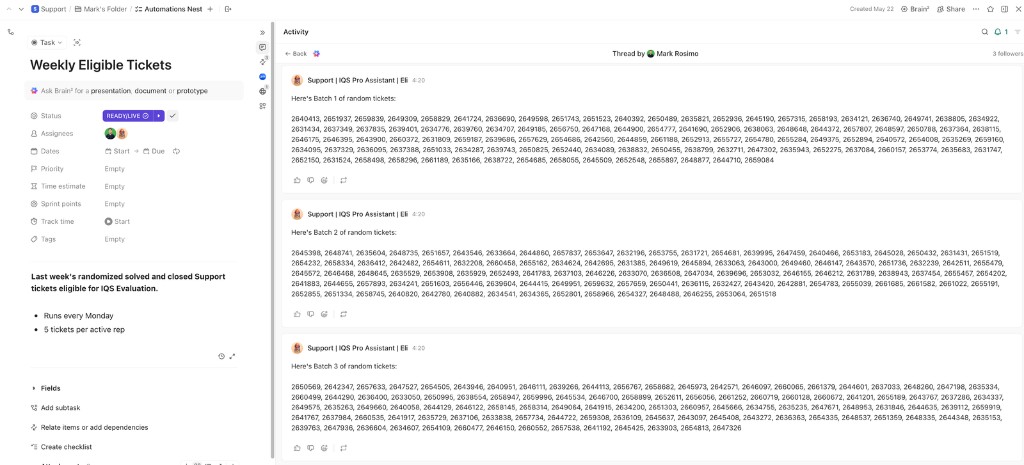
Eli, the assistant Super Agent, analyzes the previous week's tickets every Monday. Identifies which tickets are eligible for scoring, qualifies them against defined criteria, and arranges them into batches ready for evaluation.

02

A vibe-coded bridge between Zendesk and ClickUp

Qualified ticket numbers flow into a custom-built Zendesk app that Mark built. It captures full metadata and transcripts. One button click sends the payload through Zapier into ClickUp as a task comment ready for evaluation.

03

Rigorous, consistent AI scoring at scale

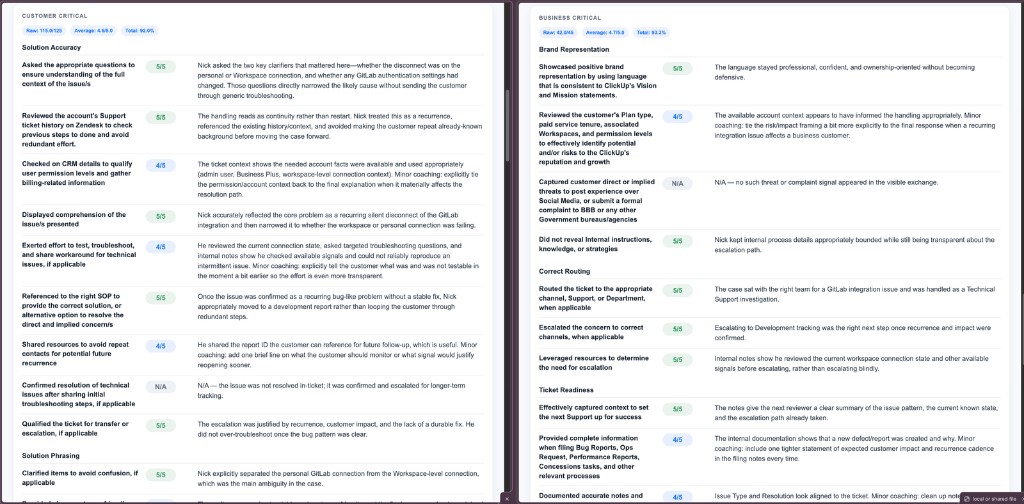
IQS Pro, the primary Super Agent, scores each ticket against the full 52-question rubric. No drift. No inter-reviewer variance. Every ticket evaluated against the same standard, every time.

04

Coaching scorecards delivered in real time

A structured scorecard lands directly with the rep or their manager: scores and ratings for all 52 rubric questions. No more waiting weeks. No more vague feedback based on faded context.

“The agents score the same way every single time. That consistency lets us have coaching conversations grounded in a shared standard instead of debating reviewer interpretation.”
Mark RosimoSenior Manager, Support Operations, ClickUp

A team that coaches instead of counts

The transformation is about what happens when a QA team stops manually scoring and starts strategically coaching.

5x

Weekly scorecards scored automatically

0

Scoring variance across a 52-question rubric

2 min

Per-scorecard processing, end to end

Strategic reallocation

QA effort redirected entirely from manual scoring to coaching strategy, process design, and exception handling.

Decision quality over task completion

Every ticket is evaluated identically, eliminating reviewer-dependent drift that undermined fair benchmarking.

“We're expanding scope to score all interactions, bringing DQS, Digital Adoption calls, and ChatBot into the fold. The system is tooling-agnostic by design, so it migrates natively into ClickUp as we grow.”

Dan ScheltingaHead of APAC, ClickUp
Inside the workflow
Each agent owns a distinct phase of the quality loop. Together they keep the entire scoring operation running without constant human orchestration.
Weekly Eligible Tickets task with Eli posting batched ticket IDs for IQS evaluation
01Eli qualifies tickets every Monday and arranges scoreable batches. The Zendesk app + Zapier bridge deposits metadata into ClickUp.
IQS Pro scorecard with Customer Critical and Business Critical rubric scores and AI coaching feedback
02IQS Pro triggers on incoming tickets, scores against the 52-question rubric, and delivers structured coaching scorecards in real time.
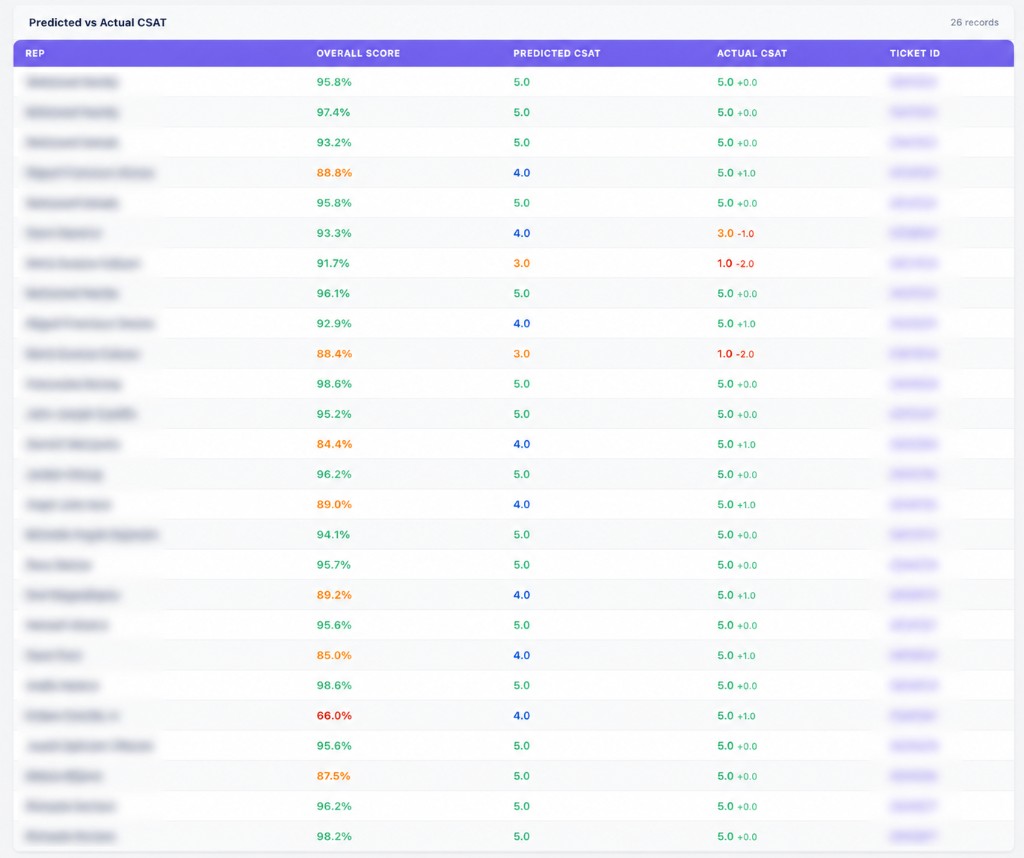
Predicted vs Actual CSAT table comparing IQS Pro scores with live customer satisfaction
03Predicted vs actual CSAT sits beside overall quality scores, so coaching goes to the tickets that need it.
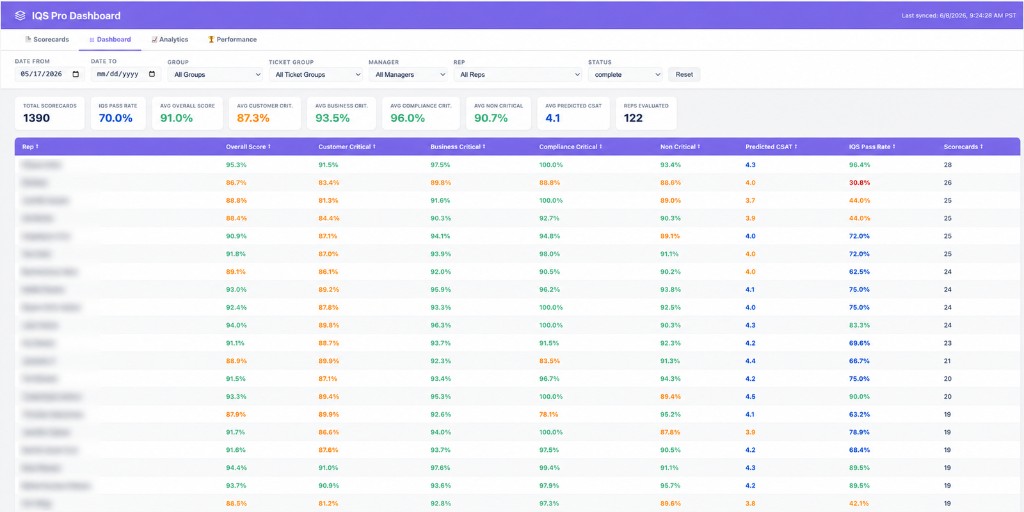
IQS Pro Dashboard with pass rate, average scores, and rep-level quality metrics
04Scorecards and dashboards land with reps and leaders so QA time goes into coaching, not counting.

Who Should Steal This

The Support Ops agent system is a living blueprint and one of the strongest examples of AI agents driving real operational change.
  • Customer Support managers who are still manually reviewing support quality with rubrics and spreadsheets
  • Anyone drowning in QA backlogs where coverage is a fraction of total volume
  • Support orgs where reps wait days or weeks for feedback on their interactions
  • Managers who want AI agents as a standard part of how they operate QA at scale

How to build this yourself

Mark's system chains two agents, a custom app, and a webhook bridge into one loop.
  1. Pick one complete operational loop

    Like ticket qualification, rubric scoring, scorecard delivery. Set it up as its own agent.

  2. Name the agent after the job

    Eli qualifies tickets. IQS Pro scores them. You get the idea.

  3. Define inputs, decision logic, and outputs

    Be explicit about where data comes from, what the agent can decide, what it must produce, and when it has to stop and wait.

  4. Keep the human in the loop for judgment

    The agent scores; the human coaches. The agent qualifies; the human reviews exceptions.

Want results like this?

Do more with Super Agents

Talk with an expert about adapting this Super Agent army in your workspace, and see how we run ClickUp on ClickUp.