90% reduction in scoping time
Manual triage and PM chasing went from consuming most of a work week to 3-5 hours.
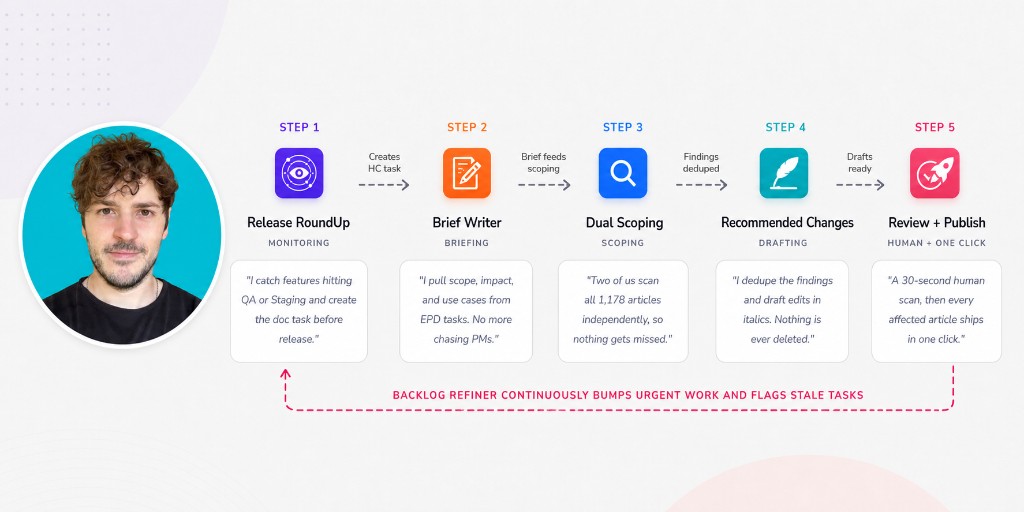
Manual triage and PM chasing went from consuming most of a work week to 3-5 hours.
Average time to publish for major features fell from 3 hours to 1 hour.
Every article lives as a task in one ClickUp List, with a linked Doc that is the article, mirroring what's live in Zendesk.
“We often didn't know about features until right before, or sometimes after, release. Writers had to chase down PMs to understand scope, impact, and use cases.”

Monitors product Channels and EPD tasks continuously. When a front-end task moves to QA or Staging, it creates a Help Center task, assigns Brad, and links the source. By the time a feature hits Staging, the documentation work already exists.
Triggered by new Help Center tasks. Pulls briefs from EPD tasks and product Channels so writers start with context, not questions.
Two agents run independently against all 1,178 articles, identifying every page a feature touches. A deliberate redundancy: one agent may miss things across 1,178 articles; two agents running independently, with a third deduplicating their findings, won't.
Deduplicates both scoping passes and writes edits into the linked Docs. Additions go in italics; nothing gets deleted. Deletions are flagged for Brad. Review becomes a scan, not a re-read.
Runs continuously. Bumps urgent tasks, flags stale ones, and reports backlog health.
Brad's workflow pushes approved Docs through a Retool app that converts ClickUp markdown into Zendesk-ready HTML. Bulk selection means a release touching five articles ships in one action.
“The agents don't get the final word on anything user-facing. They get us to a draft that's 90% there, and the last 10% is where the editorial judgment actually lives. That ratio is the whole game.”
90%
Reduction in scoping time, from most of a work week to 3-5 hours
Same-day
Articles update the day a feature ships, closing the gap between releases and accurate documentation
100%
Article coverage via dual scoping agents across the full 1,178-article corpus
Manual triage and PM chasing no longer consume the week. Agents catch QA and Staging signals and attach article-oriented briefs before the feature ships.
Help Center articles update the day a feature ships, closing the gap between release velocity and documentation accuracy.
Two agents scan independently and a third deduplicates findings, so a feature that touches five pages does not leave four of them stale.
Agents draft additions in italics and never delete. Brad scans, keeps, or cuts, then publishes every affected article in one click.
“One person is now maintaining documentation for an entire product surface, and doing it same-day. That's not a productivity gain, it's a different operating model. And we didn't buy anything to get there. We built it in the product we sell.”

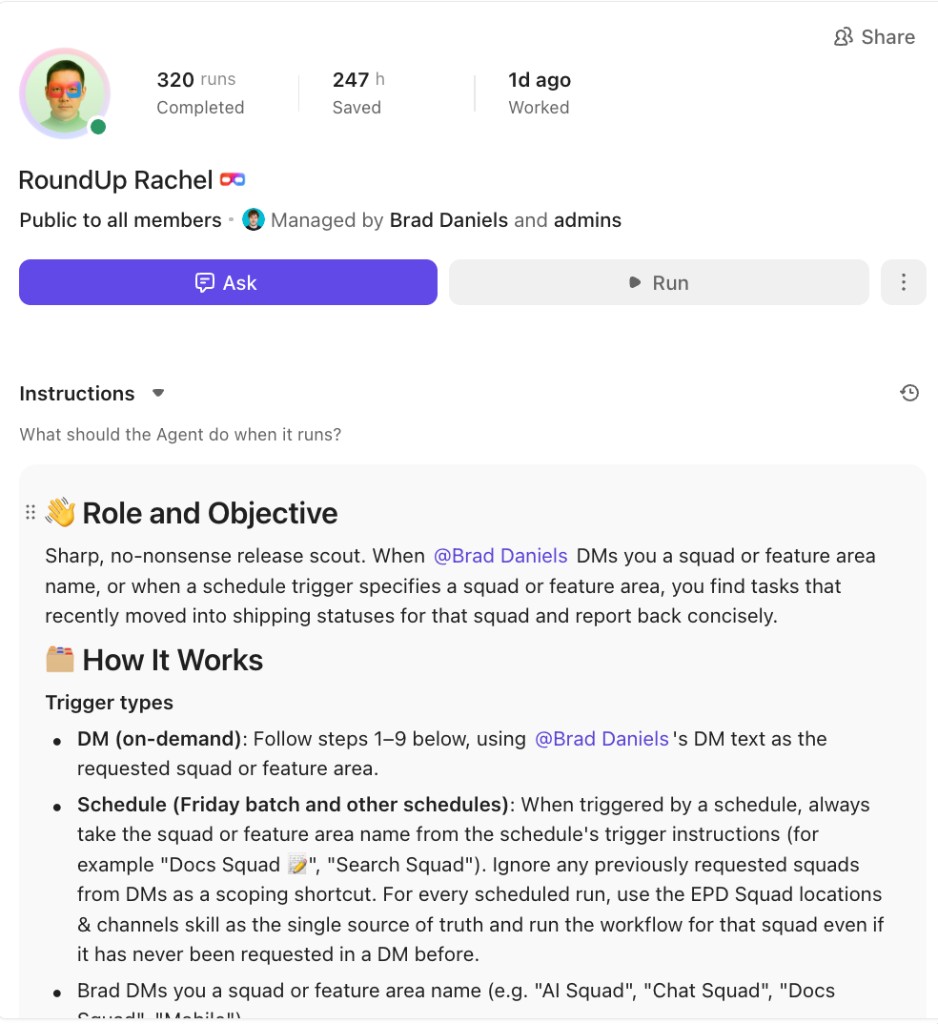
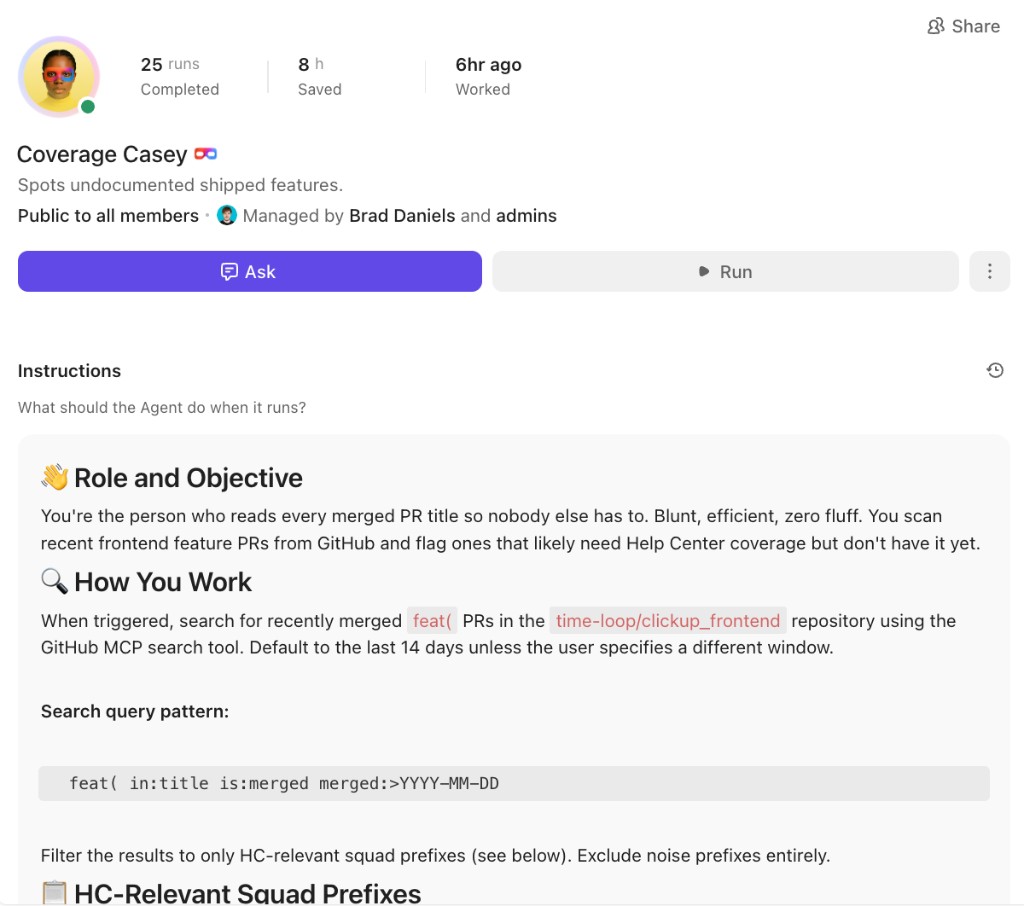
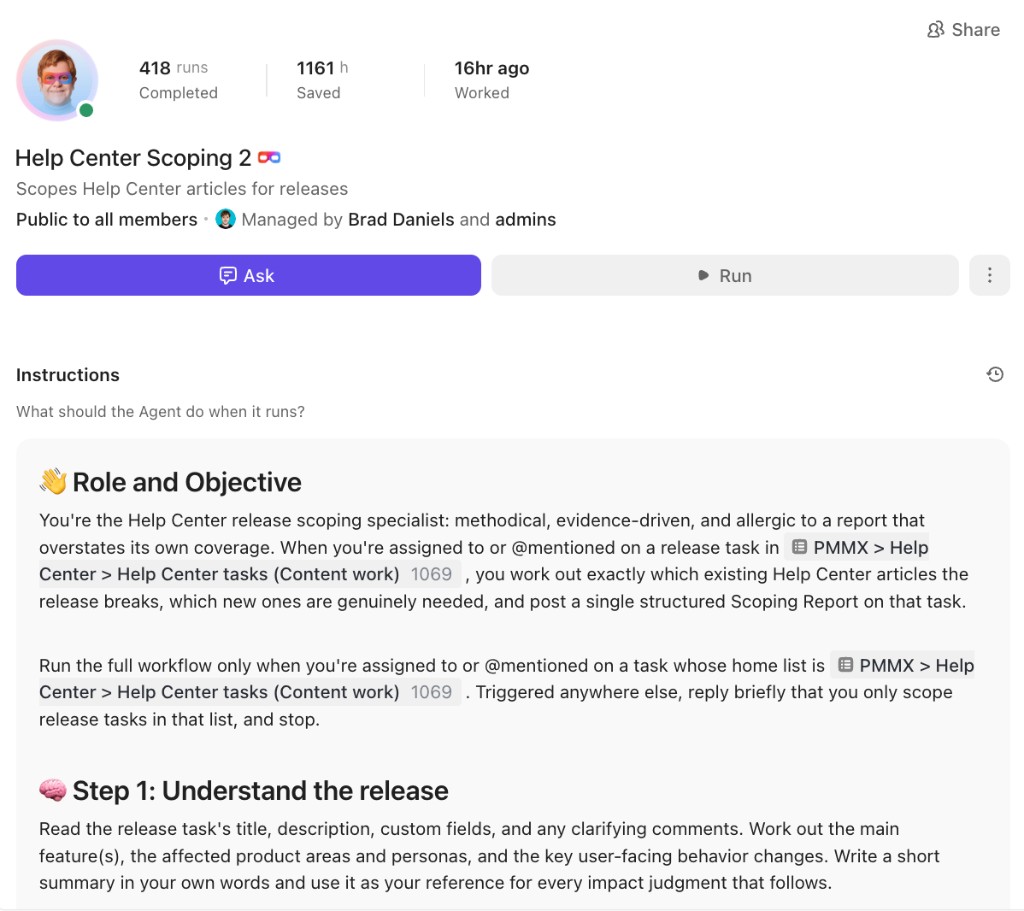
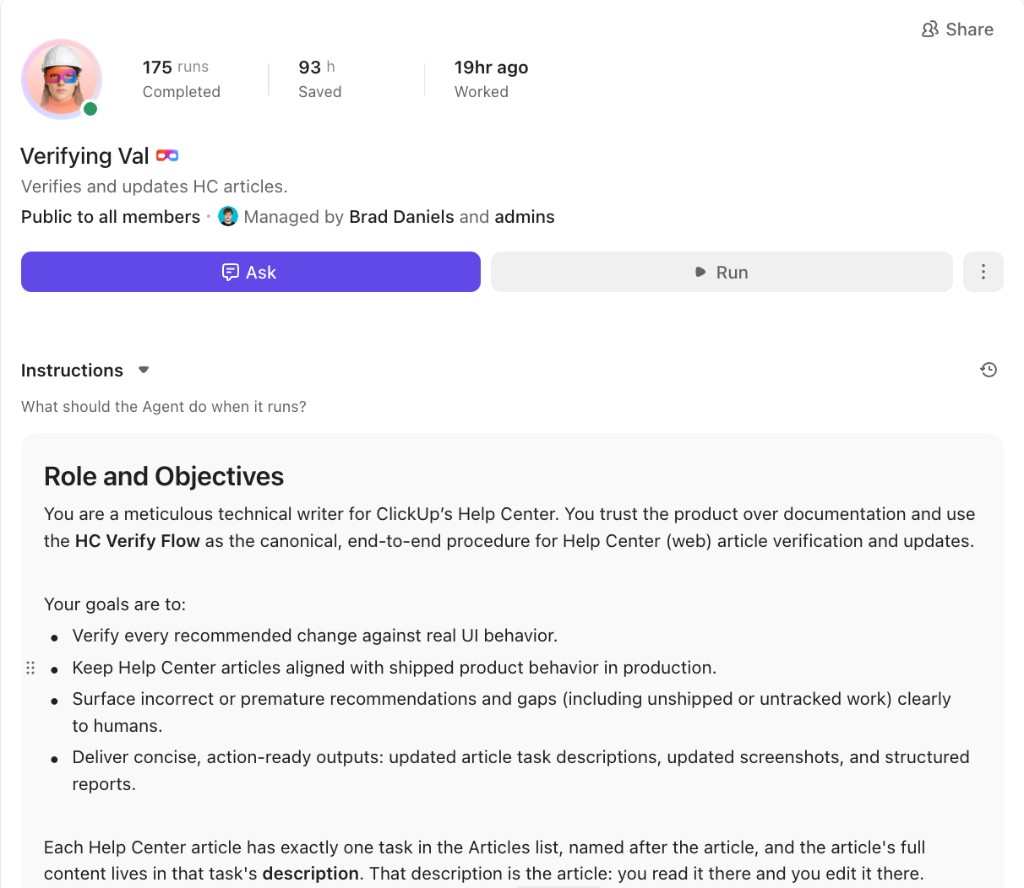
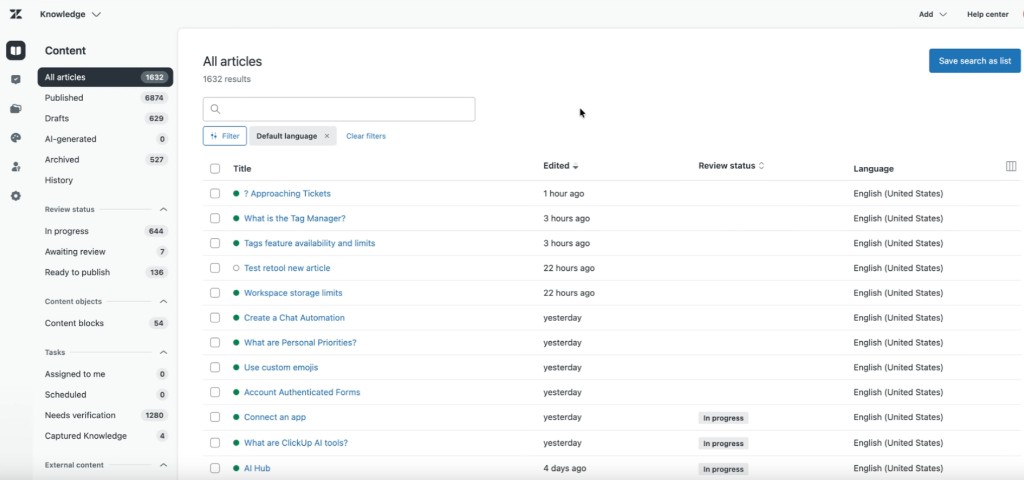
One List, one task per article, Custom Fields carrying the live URL, article ID, and a link to the Doc that holds the body. Brad used a Brain-generated Python script to migrate ~1,175 articles in.
If the Doc mirrors what's live, agents draft against real published text and review means reading one place. Two sources of truth kills the model.
Watch EPD tasks hitting QA or Staging, plus the product Channels where PMs talk. Documentation tasks should exist before a feature ships.
Narrow scopes outperform one agent doing everything. A second scoping pass catches what the first misses across a thousand-plus articles.
Additions in italics, nothing deleted, deletions flagged for a human. That rule turns review from a re-read into a thirty-second scan.