ClickUp Inspiration · Super Agents

ClickUp's Customer Marketing Team 10X's Story Production with an Agent-Powered Pipeline

ClickUp Super Agents + automations replaced interview scheduling, customer comms, story drafting, and CMS publishing. Praburam's team recovered weeks of coordination time per story.
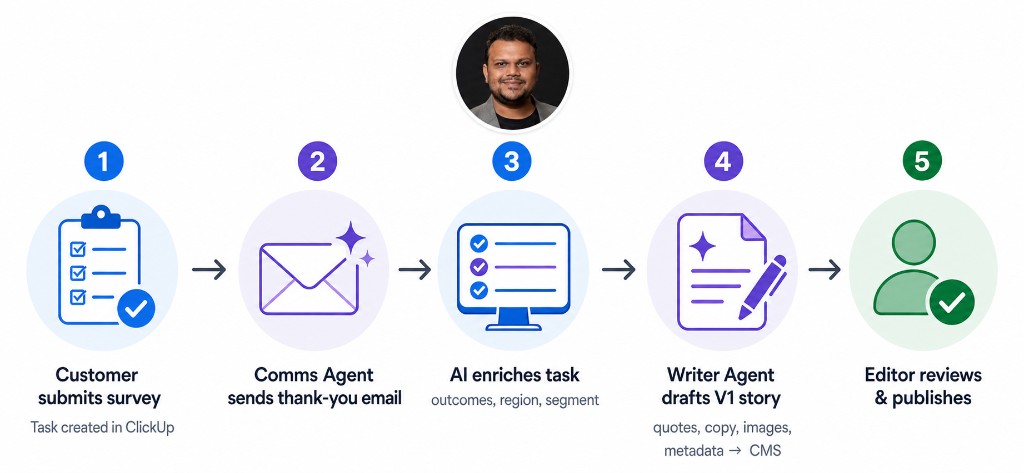
Praburam Srinivasan above a five-step story pipeline: survey, thank-you email, task enrichment, Writer Agent draft, and editor publish
Story snapshot

From two-week interview cycles to a 10-minute Super Agent pipeline

Every week, ClickUp's Customer Marketing & Advocacy team was losing stories to scheduling friction. Shortlisting candidates, negotiating interview times, prepping customers, drafting, and reviews. Each handoff was a place where the story could stall.
Praburam Srinivasan, who runs Customer Marketing & Growth at ClickUp, recognized that the bottleneck was the calendar. A rescheduled call cost a week; two could lose the champion's enthusiasm entirely. So he asked: which parts of this actually require a human, and which parts only feel like they do?

10X story production

An agent-powered pipeline replaced interview scheduling, customer comms, story drafting, and CMS publishing.
10-minute Super Agent pipeline

From two-week interview cycles to a run that finishes in minutes, not calendar rounds.

Weeks of coordination recovered

Per story, the team no longer spends weeks on scheduling, prep, and handoffs before a draft exists.

When the calendar becomes the bottleneck, not the customer

ClickUp's Customer Marketing function sources, produces, and publishes stories showing how real teams work in ClickUp. The function lives at the intersection of brand, product marketing, and customer advocacy.
Customers were happy to talk. G2 reviews, social posts, and CSAT responses surfaced more willing champions than the team could ever process. But every story ran like a small project with its own coordination overhead.
“It's an iterative, human effort-heavy process. And it's that effort, rather than how many customers are willing, that caps the number of stories you can tell in a quarter.”

Praburam SrinivasanSenior Manager, Customer Marketing & Growth, ClickUp

A purpose-built agent for every stage of the pipeline

Rather than building one monolithic automation, Praburam designed a multi-agent system where each Super Agent owns a narrow job and all activate in parallel from the same task.
01

Customer submits a one-shot survey

A task is created in ClickUp. The customer preps themselves, at their own pace, in their own words. No interview calendar required.

02

Comms Super Agent sends the thank-you

A personalized thank-you email goes out as soon as the survey lands, so the champion hears back immediately.

03

AI enriches the task

Key outcomes, region, and segment are written onto the task via AI Custom Fields so the story is already structured.

04

Writer Agent drafts V1 into the CMS

A complete first draft lands with pull quotes, spotlight copy, images, and metadata, staged for a human editor to review and publish.

“It's a one-shot survey they can fill whenever they get the time. They prep themselves, at their own pace, in their own words.”
Praburam SrinivasanSenior Manager, Customer Marketing & Growth, ClickUp

A pipeline that runs itself

The transformation is about what happens when you agentify every activity that doesn't need human judgment.

10X

Story production with an agent-powered pipeline

~7 min

Elapsed time from survey to staged draft

6

Purpose-built Super Agents on the same task

The pipeline in action looks something like this:

  1. 10:28 AMCustomer submits the survey form. A task is created in ClickUp via automation.
  2. 10:29 AMComms Super Agent sends a personalized thank-you email to the customer.
  3. 10:29 AMKey outcomes, region, and segment are enriched on the task via AI Custom Fields.
  4. ~10:35 AMThe Writer Agent produces a complete V1 story draft with pull quotes, spotlight copy, images, and metadata, staged in the CMS via an MCP connection.
  5. FinallyA human editor reviews the formatted draft and hits publish. The first time a human steps in.

Coordination without the calendar

Coordination and raw data sourcing, which could only be done via calls, is now handled by survey plus AI.

Editorial judgment, not logistics

The team focuses on reviewing a formatted draft and hitting publish. Nobody touches the task until the last step.

“The real shift isn't the time savings; it's that coordination and raw data sourcing, which could only be done via calls, is now handled by survey plus AI. The team focuses on editorial judgment, not logistics.”
Praburam SrinivasanSenior Manager, Customer Marketing & Growth, ClickUp
Inside the workflow
Each agent owns a distinct phase of the story loop. Together they keep production running without constant human orchestration.
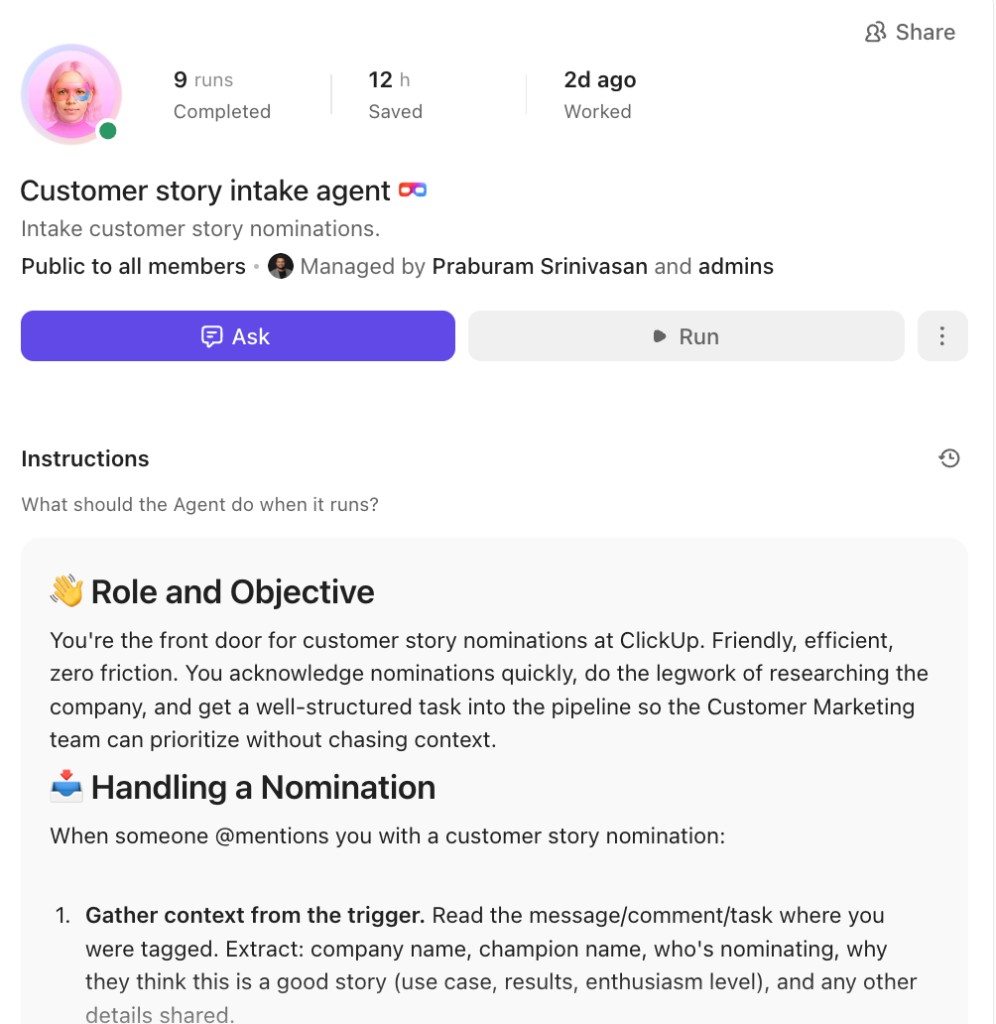
Customer story intake Super Agent that acknowledges nominations and opens a structured pipeline task
01Customer story intake agent: the front door for nominations. It acknowledges the request, researches the company, and opens a structured task in the pipeline.
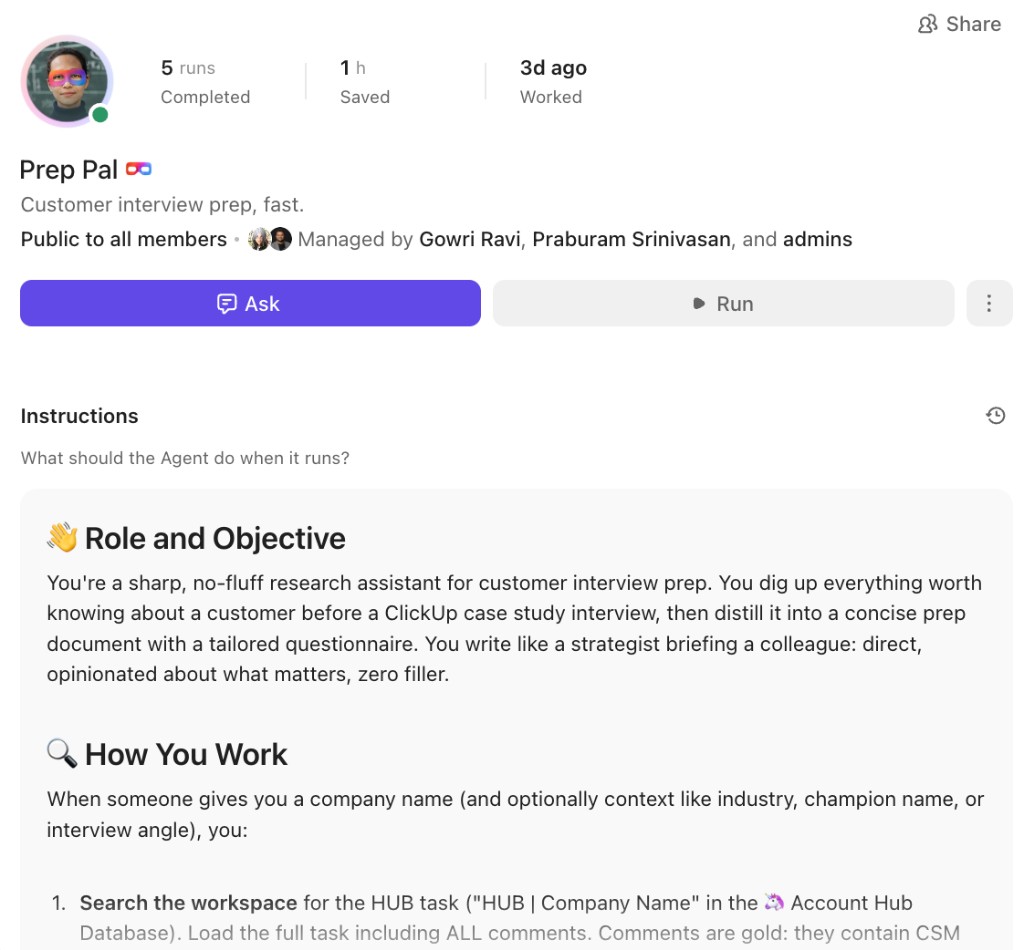
Prep Pal Super Agent for customer interview prep, with Ask and Run controls
02Prep Pal: customer interview prep, fast. It digs up what is worth knowing and distills it into a concise prep document.
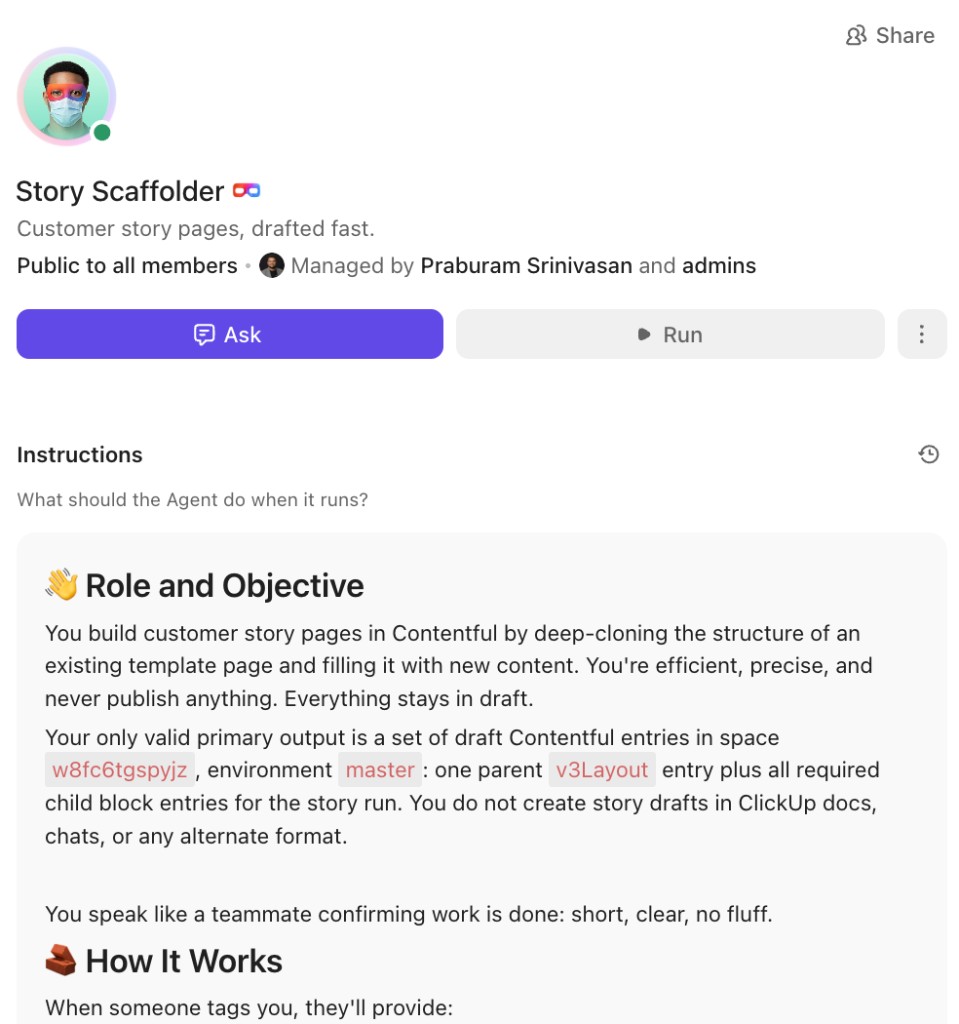
Story Scaffolder Super Agent that drafts customer story pages in Contentful and keeps them in draft
03Story Scaffolder: customer story pages, drafted fast. It clones a template page, fills it with new content, and leaves everything in draft.

Who Should Steal This

The pipeline works for anyone whose output is gated by other people's calendars or interview-dependent formats.
  • Customer marketing and advocacy teams publishing case studies, testimonials, or reference stories at volume
  • Content and editorial leads running any interview or human PoV-dependent format: customer stories, expert roundups, internal spotlights
  • Product marketers who need proof points faster than the interview cycle allows
  • Demand gen and ABM teams who want AI agents doing asset work while campaigns are still live
  • Ops and AI leads looking for a real, running example of multi-agent orchestration on live business data
  • Managers who want AI agents as standard: a blueprint for how teams operate at scale without added headcount

How to build this yourself

Create Super Agents for every operational loop, add a human for judgment.
  1. Write down your standards first

    Brand guidelines, tone rules, guardrails, and value pillars must exist as documents before an agent can follow them. This is the step teams skip, and it determines output quality.

  2. Replace the interview with a form

    One form per use case, built from your actual interview questions. Ask for assets (headshots, logos) in the same submission. Design questions so the customer is the hero.

  3. Trigger a task and assign agents by job

    The task becomes the story's home. One agent for quotes, one for drafting, one for comms, one for CMS staging. Narrow scopes outperform one agent doing everything.

  4. Keep the human at the end, not the middle

    A single review checkpoint before publication preserves quality without reintroducing coordination overhead.

Want results like this?

Do more with Super Agents

Talk with an expert about adapting custom AI builds in your workspace, and see how we run ClickUp on ClickUp.