Global VP Builds an AI Coach for Every Rep

Kyle Coleman’s AI agent synthesizes feedback, attainment data, and competency frameworks into individualized coaching plans. 'Coaching Coach' eliminates weeks of manual manager prep and helps create a transparent, data-backed performance culture at ClickUp.
Story snapshot

From gut-feel coaching to AI-driven performance intelligence

Before this system, ClickUp’s sales leadership relied on fragmented feedback loops, outdated attainment snapshots, and manual manager assessments that consumed time without producing consistent insights.
Kyle Coleman, Global Vice President, Marketing and Inside Sales, recognized that ClickUp's own Super Agents could synthesize multiple data sources into a structured, repeatable coaching framework. The AI coach was designed to increase rep attainment by 20%, decrease average deal time by 30%, and increase win rates by 15%.

Monthly coaching cycles automated end-to-end

A single AI agent synthesizes feedback, attainment data, and competency frameworks into individualized plans.

7 competencies scored per rep, per month

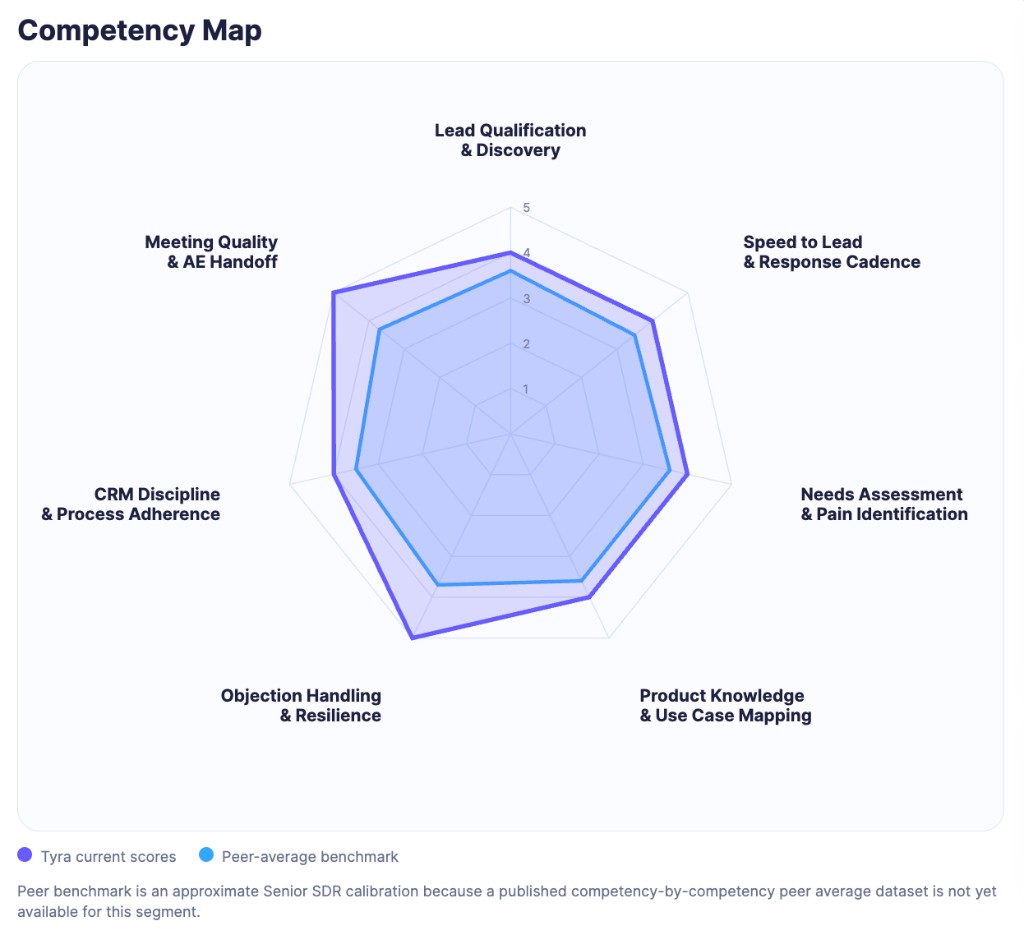
Reps are evaluated against role-specific frameworks (including SPICED), with spider charts showing peer benchmarks.

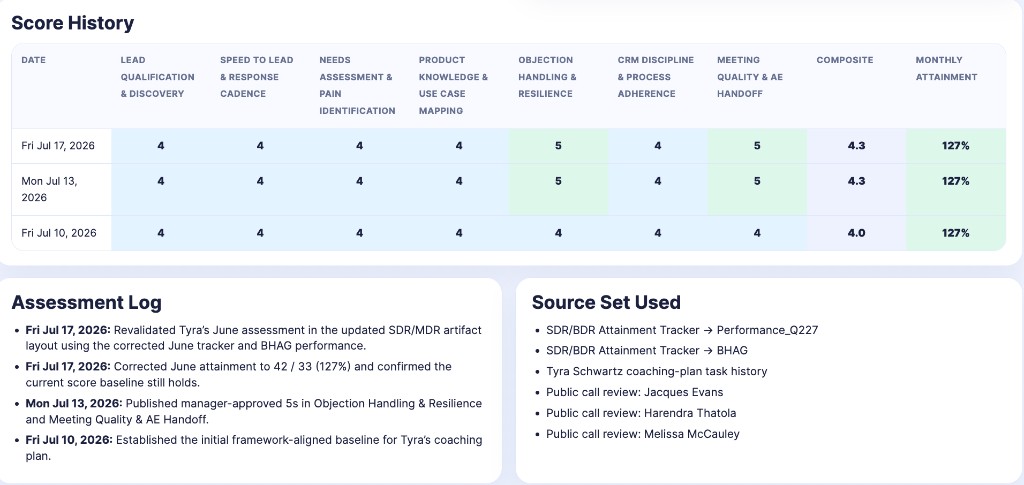
One unified task per rep houses their growth history

Coaching plans, scoring history, spider charts, and manager overrides live in a single ClickUp task.

A fundamentally broken system for developing reps

Evaluating rep performance at scale usually relied on black-and-white metrics: quota attainment, pipeline generated, and deals closed. The qualitative side of performance stayed trapped in the heads of individual managers, with the unrealistic expectation that they can listen to every call and make high-quality coaching decisions for every rep.
Reps never got the coaching they needed, feedback rarely arrived in real time, and there was almost no transparency around peer comparison. The result? An average quota attainment for B2B sales orgs of 47%.
Kyle recognized this was not a talent problem. It was a systems problem.
“We had competencies defined, attainment data in one place, manager feedback in another, and call transcripts somewhere else entirely. Nothing talked to each other, so coaching became whatever a manager could piece together in the fifteen minutes before a 1:1.”

Kyle ColemanGlobal Vice President, Marketing & Inside Sales, ClickUp

Turning competency frameworks into living intelligence

Kyle built role-specific competency documents for MDRs, SDRs, BDRs, AEs, and sales managers. That became the knowledge backbone of a ClickUp Super Agent called the Coaching Coach.
01

Automating the monthly coaching cycle

The Coaching Coach runs monthly, pulling manager feedback in ClickUp, attainment trends, and Gong call transcripts via the Gong MCP integration.

02

Making growth visible inside every rep’s workspace

Each rep’s coaching plan, spider chart, scoring history, and attainment trends live in their ClickUp task.

03

Benchmarking across the entire team

A team-wide leaderboard ranks scored reps by composite competency score.

“The agent knows the SPICED framework inside and out, and exactly how to score a rep against it. It evaluates discovery and qualification the same way our best managers would, for every rep, every single month.”

Andrew StansellDirector, XDR
“The Coaching Coach pings the manager saying, ‘Here is everything I found about this rep’s performance over the last month, and here is my take on what their score should be.’ Managers can override, adjust, or add another call transcript to consider.”

Jay KinderknechtRegional Director, XDR

From scattered signals to structured development

The system is designed to move the numbers that matter most.

+20%

Increase in rep attainment

30%

Faster average deal time

+15%

Increase in win rates

Automated synthesis replaces manual prep

Managers stop hunting across feedback, attainment reports, and call logs. The Coaching Coach aggregates and scores automatically.

Competency frameworks become actionable

Standards like SPICED stop being static docs and become living evaluation criteria applied consistently every month.

Peer benchmarking creates healthy transparency

Spider charts and leaderboards show reps where they stand relative to peers.

Manager judgment stays in the loop

AI assessments are starting points, not final verdicts. Managers retain override authority and add context the data misses.

“Performance equals attainment, which equals a winning culture. That flywheel, once it starts spinning, is impossible to slow down.”
Kyle ColemanGlobal Vice President, Marketing & Inside Sales, ClickUp
Inside the workflow
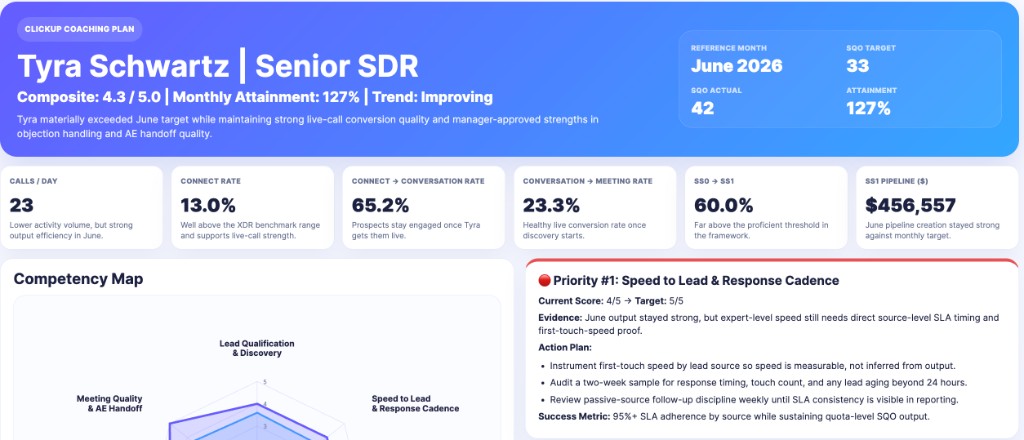
Every monthly cycle drops a living artifact onto the rep’s task: scores, spider chart, history, and prioritized coaching actions.
ClickUp Coaching Plan for Tyra Schwartz, Senior SDR, with composite score, attainment, KPI cards, competency map, and priority action
01Full coaching plan — composite score, attainment, KPIs, competency map, and the top priority action
Competency map spider chart comparing Tyra current scores to peer-average benchmark across seven sales competencies
02Competency map — current scores vs peer benchmark
Score history table with assessment log and source set used for Tyra Schwartz coaching cycles
03Score history, assessment log, and the sources the agent used
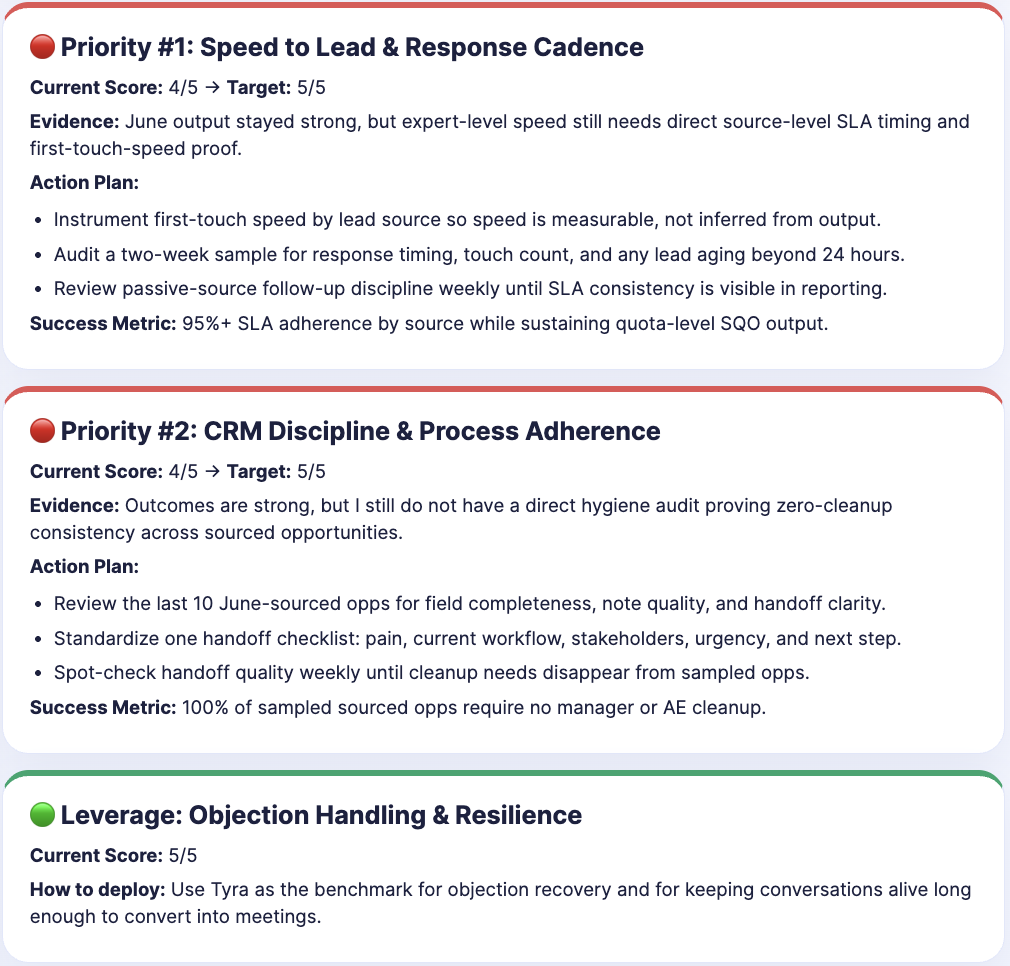
Priority coaching actions for Speed to Lead, CRM Discipline, and Objection Handling leverage
04Priority actions and leverage points the manager reviews with the rep

Who Should Steal This

The system isn't specific to sales. It works for any org where performance nuance lives in a manager's head instead of a system.
  • Sales leaders running multi-function orgs (MDR/SDR/BDR/AE) who need consistent coaching standards across teams that report to different managers
  • Enablement teams who have already written competency frameworks but watch them sit unread in a wiki
  • Frontline sales managers spending their pre-1:1 prep hunting across attainment reports, call logs, and feedback threads
  • RevOps leads who own the attainment data but have no mechanism to connect it to development
  • People and L&D teams in any function looking for a working example of AI-assisted performance review that keeps human judgment in the loop

How to Build This Yourself

Three layers: define the standard, wire the data, and put the artifact where the work lives.
  1. Write the competency frameworks first

    One document per role, with explicit 1–5 criteria for each dimension. Vague standards produce vague scores.

  2. Anchor evaluation in a named methodology

    SPICED, MEDDIC, or whatever your team already runs. The agent and your people need the same vocabulary.

  3. Connect the data sources

    Manager feedback, attainment trends, and call transcripts. Fix anything an agent can’t read before you build.

  4. Run it on a fixed cadence

    Monthly is enough to show a trend without becoming noise. Consistency beats frequency.

  5. Notify the manager — don’t replace them

    AI drafts a scored assessment with evidence. Managers override, add context, and approve the final score.

  6. Give every rep one task as their home

    Coaching plan, spider chart, and scoring history accumulate in one place instead of resetting each cycle.

Want results like this?

Put the same coaching system to work on your team

Talk with an expert about adapting Coaching Coach in your workspace — and see how we run ClickUp on ClickUp.